
Ask ten writers what a beat is and you'll get ten answers. In a screenplay, "beat" can mean a pause in dialogue. In a writers' room, it can mean a story point on an index card. In outlining, it can mean a single scene's turn.
The useful definition sits underneath all of them: a beat is the smallest unit of story that changes something. A character wants something new, learns something, loses something, or chooses something. If nothing changes, it isn't a beat yet. It's description.
Name beats by what they do
Most beats fall into a handful of jobs. Naming the job is more useful than naming the content, because the job tells you whether the story is working.
- Setup. Establishes a want, a world or a rule the story will later test. Dorothy longs for somewhere beyond the gray farm.
- Inciting incident. Breaks the status quo and forces the story to begin. The cyclone carries the house away.
- Turn. Moves the story in a new direction without reversing it. Dorothy opens the door onto a country of color.
- Reversal. Flips an expectation or a fortune. What looked like safety becomes danger, or the other way round.
- Reveal. Gives the audience or a character information that reframes what came before. The house has landed on the Wicked Witch of the East.
When you can see the type of every beat in a sequence at a glance, problems show up fast. Three setups in a row usually means the story is stalling. A sequence with no turn or reversal often feels flat, however good the scenes are on the page.
Track how each beat resolves
Type tells you what a beat does to the plot. Emotional resolution tells you what it does to the audience: the feeling a moment starts from and the feeling it lands on.
Take the cyclone. It starts in hope (Dorothy wants something more than the farm) and resolves in dread (the house is torn into the sky). The very next beat, stepping into Munchkinland, starts from that dread and resolves in wonder.
Written down as a chain, the emotional line of the opening looks like this:
- Restless → Longing
- Hope → Dread
- Dread → Wonder
- Wonder → Unease
Every beat hands its ending feeling to the next one. When a story feels emotionally monotonous, it is usually because too many beats resolve to the same place. When it feels jarring, it is often because one beat starts somewhere the previous beat didn't leave the audience.
Beats only matter in context
A beat on its own is an index card. Its meaning comes from where it sits:
- In a sequence, alongside the beats that lead into it and out of it.
- In an act, where it carries part of a larger turn.
- In a place. The same reveal plays differently in a farmhouse than in a throne room, and knowing which beats happen where helps you see whether a location is earning its place in the story.
This is where most development workflows break down. Beats live on cards or in a spreadsheet, the script lives in a screenwriting app, locations live in someone's notes, and the connections between them live in the writer's head.
Seeing the whole structure
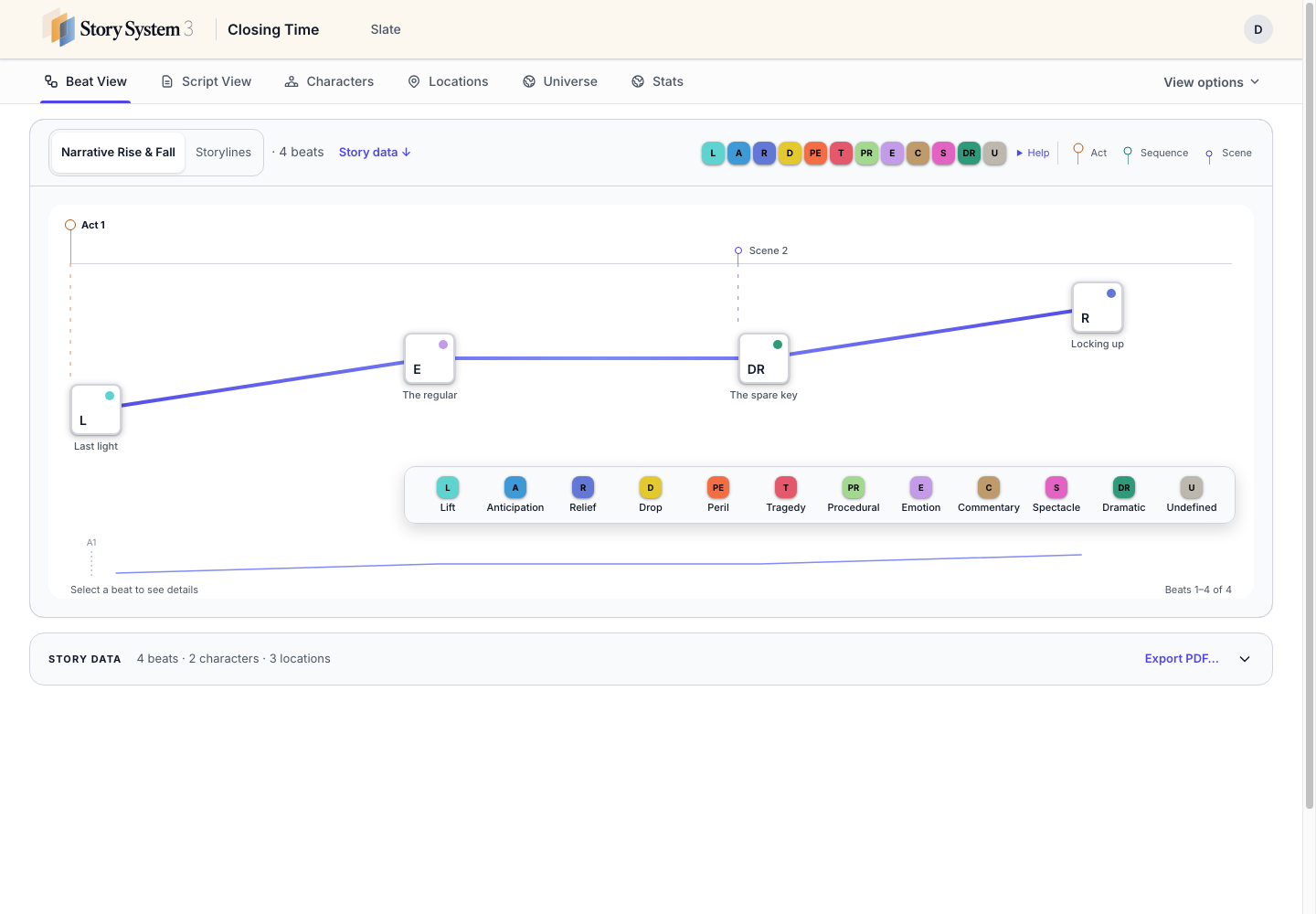
Story System keeps these layers connected. Every beat carries its type and its emotional resolution, sits inside a sequence and an act, and links to the location where it happens. You can arrange beats in a sequence, then move into formatted screenplay and keep editing in either direction. If you already have a draft, bring in the screenplay file and its beats, scenes, acts and locations resolve into structure you can work with.
The point isn't to turn writing into a spreadsheet. It's to make the shape of the story visible, so the decisions you make about it are deliberate.
You can see the interactive demo, explore plans and pricing, or read more about the idea behind it in What is a narrative operating system?.